
A single inconsistency in your application process can be the difference between a profitable lease and a costly legal dispute. While most property owners aim to be fair, the technical nuances of the Florida Fair Housing Act often turn routine background checks into a legal minefield. It's understandable to feel overwhelmed by shifting HUD guidance on criminal records or the complexities of verifying service animals without overstepping your bounds.
This guide provides a clear path forward for florida fair housing tenant screening so you can protect your investment and avoid expensive mistakes. You'll learn how to establish a repeatable, objective process that treats every applicant with the same high standard of professionalism. We will cover the specific requirements for reasonable accommodations, the legal limits on rejecting criminal history, and the documentation strategies needed to prove your compliance if a complaint ever arises. By the end, you'll have the tools to find reliable tenants while maintaining a rock-solid defense for your business.
Key Takeaways
- Identify the seven protected classes under federal and state law to ensure your rental policies remain fully compliant with all Fair Housing standards.
- Implement a uniform process for florida fair housing tenant screening by providing written criteria to every applicant before accepting application fees.
- Navigate the complexities of reasonable accommodations by understanding why assistance animals are not classified as pets under Fair Housing regulations.
- Build a robust documentation trail that records every inquiry and application to protect your investment from potential discrimination claims.
- Learn how expert property management and professional tenant placement can mitigate risk and maintain high standards of fairness throughout the leasing process.
The Legal Landscape: Florida Fair Housing Act vs. Federal FHA
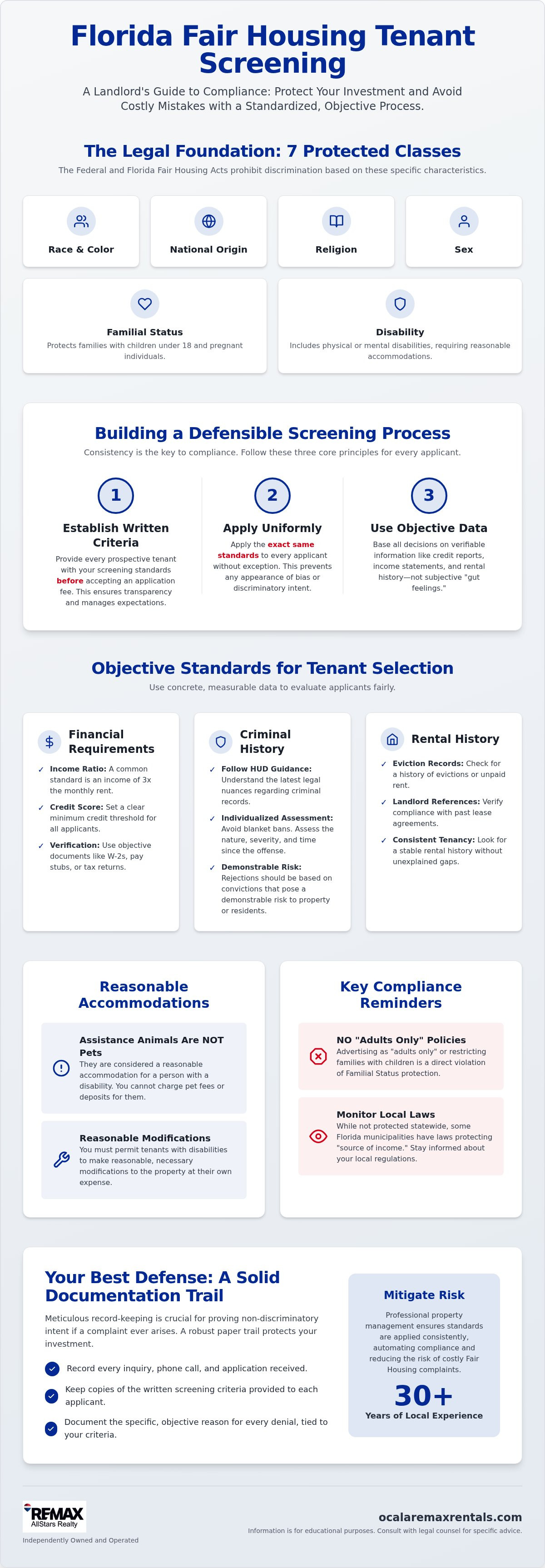
Compliance begins with a clear understanding of the laws governing your rental property. The Federal Fair Housing Act serves as the primary national standard, prohibiting discrimination based on seven specific protected characteristics. These classes include race, color, religion, national origin, sex, disability, and familial status. In Florida, these federal protections are codified within the Florida Fair Housing Act, found in Florida Statutes §§ 760.20-760.37. This state-level integration ensures that Florida agencies have the authority to investigate and penalize violations directly.
Successful florida fair housing tenant screening requires more than just a passing knowledge of these categories. It demands a disciplined approach to every interaction, from the first phone call to the final lease signature. For landlords in Ocala and the surrounding Marion County area, 2026 brings an increased focus on state-level enforcement and transparency. While federal law sets the floor, Florida’s regulatory environment creates a specific framework for how these protections are applied in daily property management operations. Adhering to these standards isn't just about ethics; it's a fundamental strategy for risk mitigation.
Protected Classes in Florida
The protection for familial status remains a common area of confusion for many independent owners. This class protects families with children under the age of 18, as well as pregnant women. You cannot legally restrict a family from renting a unit simply because of the presence of children or specify "adults only" in your advertisements. Additionally, protections for individuals with physical or mental disabilities require landlords to allow reasonable modifications to the premises or accommodations in rules. While source of income is not currently a protected class under statewide Florida law, it's an evolving legal topic in various Florida rental markets that landlords should monitor closely to ensure their screening criteria remain objective.
Local Considerations for Ocala and Marion County
Landlords in Ocala must recognize the role of the Florida Commission on Human Relations (FCHR). This body handles many of the complaints that might otherwise go to federal HUD offices. In Marion County, maintaining consistency is the best defense against a complaint. Using a standardized $50.00 application fee for every adult applicant, for instance, demonstrates a commitment to fairness. When you apply the same financial and background standards to every individual, you create a transparent process that is difficult to challenge. Relying on 30 plus years of local experience helps ensure that your screening practices align with both state mandates and local municipal expectations.
Developing Legally Compliant Tenant Screening Criteria
Establishing a set of neutral criteria is the foundation of a defensible screening process. You must apply the exact same standards to every applicant without exception. This consistency prevents the appearance of bias and provides a clear framework for your decisions. Florida law requires transparency; therefore, you should provide these written screening criteria to every prospective tenant before you accept an application fee. By doing so, you ensure that applicants understand the requirements for approval, which reduces friction and potential disputes.
Many owners find that partnering with a professional property management ocala fl firm is the most effective way to automate this consistency. A structured approach ensures that every step, from the initial inquiry to the final background check, follows a documented protocol. This level of discipline is essential for maintaining compliance with the Florida Commission on Human Relations standards. When your process is automated and standardized, you remove the subjective "gut feelings" that often lead to Fair Housing complaints.
Financial and Credit Requirements
Financial stability is a primary factor in a successful tenancy. You should set a clear minimum credit score threshold that applies to all applicants. A common industry standard is an income-to-rent ratio of three times the monthly rent. This requirement should be verified through objective documentation such as W-2 forms, recent pay stubs, or tax returns. Using these concrete data points allows you to make decisions based on financial capability rather than subjective impressions. This helps maintain a fair environment for all parties involved.
Criminal Background and Rental History
Evaluating an applicant's past requires a nuanced approach. While you can certainly look at rental history, it's best to set a specific timeframe for prior evictions, such as a five-year look-back period. Blanket bans on criminal records are legally risky and often conflict with the 2016 HUD Guidance. This guidance emphasizes that housing providers must distinguish between arrests and convictions. An arrest alone does not prove criminal conduct. Your policy should focus on specific types of convictions that might pose a direct threat to the property or other residents.
Creating a repeatable process for florida fair housing tenant screening doesn't just protect you from legal errors; it also helps you find the most reliable residents for your investment. If you're unsure about how to structure these requirements, consulting with a firm that specializes in residential property management can provide the clarity you need to move forward with confidence.
Reasonable Accommodations: Pets vs. Service and Support Animals
One of the most frequent points of friction in florida fair housing tenant screening involves the presence of animals. It's vital to recognize that under the law, service animals and emotional support animals (ESAs) are not classified as pets. They are considered assistive devices, similar to a wheelchair or an oxygen tank. Because of this legal status, a property's "No Pet" policy cannot be used to deny an applicant who relies on a verified assistance animal. Refusing to rent to an individual because of their need for an assistance animal is a primary cause of discrimination complaints.
Financial policies must also adjust for these accommodations. You cannot charge a pet deposit, a non-refundable pet fee, or monthly pet rent for an assistance animal. Doing so is a direct violation of Florida landlord-tenant laws and can lead to immediate legal repercussions. While the tenant remains responsible for any physical damage the animal causes to the property, the initial access to the home must be provided without additional animal-related costs. Understanding these distinctions is a core part of hiring a property manager florida who can protect your interests.
Service Animals vs. Emotional Support Animals (ESA)
Service animals are defined by the Americans with Disabilities Act (ADA) as dogs specifically trained to perform tasks for an individual with a disability. In contrast, Emotional Support Animals fall under the Fair Housing Act and provide comfort that alleviates symptoms of a disability. When a disability isn't obvious, you're legally permitted to ask two specific questions:
- Is the animal required because of a disability?
- What work or task has the animal been trained to perform?
You shouldn't ask for detailed medical records or demand a physical demonstration of the animal's tasks. For ESAs, the animal does not need specific training, but the individual must have a disability-related need for the support it provides.
Verification and 2026 Documentation Standards
If a disability is not apparent, you can request a "reliable disability-related need" letter. This documentation should come from a healthcare provider with personal knowledge of the individual. In 2026, Florida standards are increasingly strict regarding "online ESA certificates" purchased from websites that don't involve a legitimate therapeutic relationship. Landlords have the right to request documentation that confirms the provider has a professional relationship with the tenant. While accommodations are mandatory, you may deny a request if the specific animal poses a documented threat to safety or creates an undue financial burden, though these cases are rare and require extensive proof of the hardship.
The Documentation Trail: Proving Non-Discriminatory Intent
A disciplined record-keeping strategy is your strongest defense against a Fair Housing complaint. In the professional management industry, we operate under a simple rule: if it isn't in writing, it didn't happen. This documentation serves as objective proof that your florida fair housing tenant screening process was applied uniformly to every individual who expressed interest in your property. You should maintain a detailed log that tracks every inquiry, showing, and application received. This log should include the date of contact and the specific outcome of each interaction.
Consistency in your documentation demonstrates that you haven't skipped steps or made exceptions based on personal bias. Generally, you should keep rental applications, credit reports, and all related screening data on file for at least two years. Many professionals recommend keeping these records for up to four years to ensure they're available if a legal challenge arises within the statute of limitations. This methodical approach creates a historical record of your compliance and ethical conduct, providing security for your investment.
Managing Application Fees and Disclosures
Transparency regarding costs is a fundamental part of a fair screening process. We maintain a strict $50.00 standardized application fee policy for every adult applicant. This clear, non-negotiable fee ensures that no applicant is given preferential treatment or subjected to higher costs than another. Beyond the fee itself, you must provide mandatory disclosures required by the Fair Credit Reporting Act (FCRA). If you use a third-party screening service to pull credit or criminal data, you're legally obligated to inform the applicant of this process. Every prospective tenant must receive the same information regarding the property’s current availability and the specific criteria used for evaluation.
Handling Denials and Adverse Action
The moment you decide to reject an application is when your documentation must be most precise. Federal law requires an "Adverse Action" notice whenever an applicant is denied based on information in a consumer report. This notice must be provided in writing and include the specific reason for the denial and the contact information for the credit reporting agency used. It must also explain that the credit agency did not make the decision to deny the application and provide instructions on how the applicant can dispute the report's accuracy.
Avoid giving verbal denials or informal explanations over the phone. These casual conversations can be easily misinterpreted and used against you in a dispute. By sticking to a formal, written Adverse Action letter, you maintain a professional distance and protect your legal position. If an applicant follows up with questions, you can refer them back to the written criteria and the formal notice. This level of precision is why many owners choose to partner with experts in residential property management to handle the technicalities of the leasing process.
Mitigating Risk: The Value of Professional Tenant Placement
Managing a rental property independently carries significant financial and legal risks that many owners overlook until a problem arises. A single misstep during the application process can lead to a Fair Housing complaint, which often results in thousands of dollars in legal fees and potential settlements. Professional management acts as a strategic insurance policy for your investment. By utilizing expert tenant placement services ocala fl, you effectively insulate yourself from the direct liability of screening decisions. We assume the responsibility of ensuring every step of the process adheres to the letter of the law.
A professional firm serves as a necessary third-party buffer between the property owner and the applicant. This distance is vital for maintaining objectivity. It ensures that every interaction remains strictly business-focused and free from personal biases that could be misinterpreted as discriminatory. When an applicant is denied, our team handles the communication according to established legal protocols. This protects you from the emotional or confrontational follow-ups that independent landlords often face. You don't have to worry about saying the wrong thing or failing to provide the correct disclosures.
Why Experience Matters in 2026
Real estate laws in Florida are not static. In 2026, staying ahead of legislative updates regarding tenant rights and local Marion County ordinances is a full-time commitment. Professional managers use advanced screening tools that provide deeper insights into credit history and criminal records than most individual owners can access. This "steady hand" approach ensures that florida fair housing tenant screening is conducted with the highest level of accuracy and compliance. We understand the nuances of current HUD guidance and how to apply it to your specific property without compromising your standards.
The REMAX AllStars Realty Approach
Our team brings over 30 years of Marion County real estate experience to every property we manage. We prioritize transparency and reliability, ensuring that every applicant is treated with the same strict ethical standards. We handle the entire lifecycle of the placement process. This includes marketing the vacancy to find the widest pool of qualified candidates, processing comprehensive background and income verifications, and executing a legally sound lease agreement. Our adherence to a standardized $50.00 application fee is a core part of our commitment to fairness.
Relying on a seasoned professional allows you to focus on the long-term growth of your portfolio while we handle the granular details of compliance. We provide the stability and expertise needed to navigate the complexities of the modern rental market. If you're ready to protect your investment and find reliable residents who pay on time, our team is prepared to assist you. Contact REMAX AllStars Realty to secure a compliant tenant today.
Securing Your Investment with Reliable Compliance Standards
Maintaining a lawful rental business requires a commitment to objective standards and meticulous record-keeping. A successful florida fair housing tenant screening process relies on neutral criteria, a clear understanding of assistance animal regulations, and a documented trail for every applicant interaction. These steps don't just prevent legal errors; they ensure you find high-quality residents who respect your property and fulfill their lease obligations. By prioritizing transparency and consistency, you build a reputation for ethical conduct that attracts the best tenants in Ocala.
Navigating these requirements alone can be a complex and time-consuming undertaking. As an independently owned and operated RE/MAX franchise, we offer 30 plus years of Marion County property management experience to help you manage these technicalities. We utilize a standardized $50.00 application fee for total transparency, ensuring every prospective tenant is treated with the same high level of professionalism. Protect your investment with professional tenant screening from REMAX AllStars Realty. With the right systems in place, you can grow your rental portfolio with the confidence that your business remains both profitable and fully compliant.
Frequently Asked Questions
Can I reject a tenant for having a criminal record in Florida?
You can reject an applicant based on their criminal history, but you must avoid blanket bans. HUD guidance requires landlords to distinguish between arrests and convictions. Your policy should focus on specific offenses that pose a direct threat to the safety of other residents or the property itself. Applying these standards consistently across all florida fair housing tenant screening activities ensures your process remains objective and legally defensible.
What is the maximum application fee a landlord can charge in Florida?
Florida law does not currently set a statutory maximum for rental application fees. While there is no legal cap, most fees in the state range between $30.00 and $75.00 per adult. We maintain a standardized $50.00 fee to ensure transparency and fairness for every applicant. Charging a consistent rate helps demonstrate that you aren't using fees as a discriminatory barrier to entry.
Do I have to allow an Emotional Support Animal if I have a 'no pets' policy?
Yes, you must allow an Emotional Support Animal (ESA) even if you have a strict "no pets" policy. Under the Fair Housing Act, these animals are assistive devices rather than pets. You cannot charge pet rent or deposits for a verified ESA. You're entitled to request a reliable disability-related need letter if the disability isn't apparent, but you must grant the accommodation if the criteria are met.
Is it legal to ask a tenant where they were born during an interview?
No, it's not legal to ask an applicant about their place of birth or citizenship status. These questions directly relate to national origin, which is one of the seven protected classes under federal and state law. To maintain compliance during florida fair housing tenant screening, focus your interview questions strictly on financial qualifications, rental history, and the applicant's ability to follow lease terms.
What should I do if a tenant accuses me of Fair Housing discrimination?
You should immediately document all interactions and cease informal communication if an accusation is made. Review your screening records to ensure your criteria were applied consistently. It's vital to consult with your property manager or legal counsel to handle the situation professionally. Having a clear documentation trail is your best defense against claims of discriminatory intent or procedural errors.
Can I require a tenant to have a specific income-to-rent ratio?
Yes, you can require a specific income-to-rent ratio as long as it's a neutral requirement applied to every applicant. A common industry standard is requiring a gross monthly income of at least three times the monthly rent. This financial requirement must be verified through objective documentation like pay stubs or tax returns. Using a set ratio helps you select qualified tenants based on their actual ability to pay.
How long does a typical Florida tenant screening process take?
A professional screening process typically takes between 24 and 72 hours to complete. This timeframe depends on how quickly employers and previous landlords respond to verification requests. We aim for a steady and thorough pace to ensure every detail of the background and credit check is accurate. Rushing the process can lead to oversights, while a methodical approach ensures you find a reliable and compliant tenant.
Do Fair Housing laws apply if I am only renting out a single-family home?
Yes, Fair Housing laws apply to nearly all residential rentals, including single-family homes. While there are narrow exemptions for some owner-occupied buildings, those exemptions disappear if you use a real estate broker or a professional management firm. Most Ocala landlords should operate under the assumption that all federal and state regulations apply to their properties to avoid significant legal risks and ensure ethical leasing practices.


